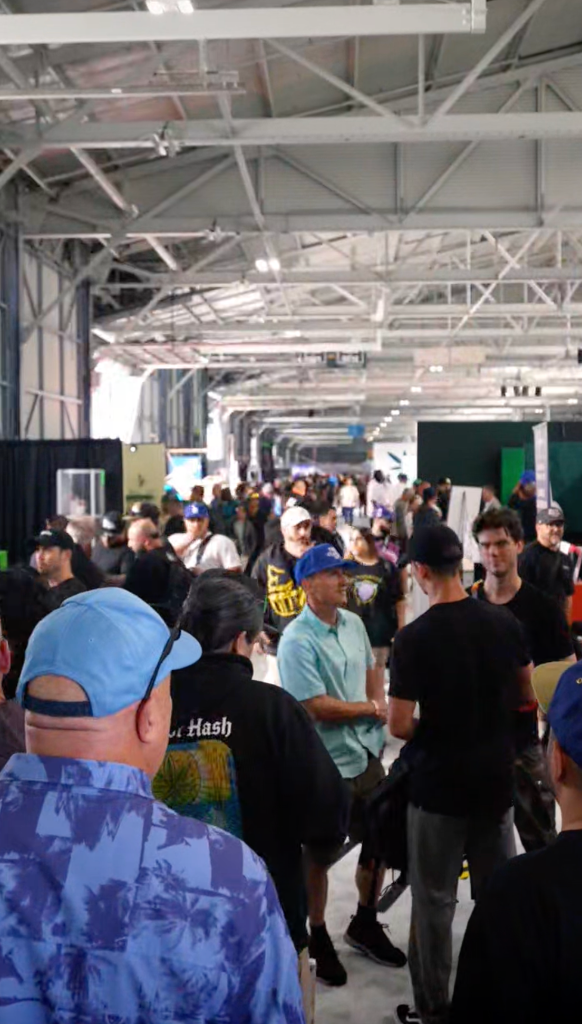
The official High Supply site describes the 2026 show as a cannabis supply-chain trade event for operators, brands, suppliers, and partners. This recap limits event facts to that public record and approved project media. High Rise’s recap focuses on what the event visibly offered: active conversations, branded spaces, product presentation, people moving through the show, and the energy that is difficult to communicate through a static announcement.
The useful marketing lesson is not simply that brands should attend more events. It is that a live appearance needs a job, a coherent experience, and a plan for what happens afterward. Presence without preparation becomes an expense. Presence connected to meetings, content, retail priorities, and follow-up can become a working part of the brand system.
What the High Supply recap captures
An event recap should make the setting understandable to someone who was not there. For High Supply, that meant showing the scale and movement of the floor, the mix of people, the visual differences between brand spaces, and the conversations happening around them. Those elements provide context that a sequence of logos cannot.
The footage also preserves details attendees may not notice in real time: how a booth reads from a distance, whether staff and signage communicate the same message, where crowds form, and which interactions look natural on camera. The recap is both a story of the event and a record brands can study.
High Rise’s event-video work is built around that dual role. The finished piece should be watchable, but the capture should also give the host and participating brands useful material for continued communication.
A show-floor presence is a complete experience
A booth is not just rented space. It combines physical design, message hierarchy, staff behavior, product education, hospitality, and the action a visitor is expected to take. When those parts disagree, the visitor has to do too much work to understand the brand.
High Supply made those differences visible. Some spaces could be understood quickly because the presentation, people, and activity reinforced one another. Others depended on close explanation. That does not mean every brand needs a large build. A smaller footprint with a clear purpose can be more effective than an elaborate space with no obvious reason to enter.
The first planning question should therefore be commercial: what should happen here? The answer might be a buyer meeting, product education, a qualified lead, a creator interaction, a retail conversation, or a memorable consumer touchpoint where the format and rules permit it. The space should be designed around that action.
Visual identity has to work in motion
Packaging and campaign graphics are often reviewed close-up on a screen. A trade-show environment tests them differently. Signage must read across a moving crowd. Product displays need enough hierarchy to make sense quickly. Staff attire, fixtures, color, and materials either strengthen the identity or introduce noise.
That is why event planning should connect to the broader brand-design system. The goal is not to make every surface identical. It is to preserve the recognizable decisions—type, color, tone, product organization, and message—while adapting them to distance, traffic, light, and physical use.
Photography should be considered at the same time. Reflective materials, low light, crowded sightlines, and clutter can make a strong space difficult to capture. A short camera test before the doors open can reveal changes that improve both the attendee experience and the eventual recap.
The people in the space carry the brand
Staff preparation is part of creative execution. Visitors remember whether someone could explain the product, direct them to the right person, answer a retail question, or capture follow-up information without friction. The most polished environment can still fail if responsibilities are unclear.
A useful event brief names the host, product expert, buyer contact, content contact, and person authorized to solve problems. It defines the main message, prohibited claims, qualification questions, and follow-up process. Staff should know which conversations need a scan, a note, an introduction, or no data collection at all.
Training should also cover the capture plan. People need to know when interviews or photographs are scheduled, which areas should remain clear, and how consent or release requirements will be handled. That coordination keeps content production from competing with hospitality.
Content should be planned before the show opens
High Supply moved quickly, as live events do. A crew without priorities would return with hours of similar crowd footage and still miss the moments partners actually need. The capture plan should identify the event story, required brand moments, interviews, environmental shots, product details, vertical formats, and closing sequence.
Each format has a different job. The official recap establishes the complete experience. Short vertical edits create discovery and social conversation. Still images support galleries, email, partner reporting, and future promotion. Interview clips can provide operator perspective when the speaker and context are properly identified.
High Rise treats this as a content system, not a single deliverable. The production brief connects capture to distribution, so the crew knows why a shot matters and the marketing team knows where the approved asset will go.
Networking needs an operating plan
Trade events concentrate people who may otherwise take months to meet. That access is useful, but a conversation is not a result until the team records the context and follows up appropriately. Collecting a stack of badges or scans without qualification creates another cleanup project.
Before the event, define priority accounts and meetings. During the show, record the person, company, topic, owner, and promised next action. Afterward, separate buyer, partner, media, creator, vendor, and general conversations so each receives relevant follow-up.
The event team should also protect time. Staffing a booth, attending meetings, capturing content, and walking the floor are different responsibilities. When one person is expected to do all four, important conversations and documentation are easily lost.
The event strategy has three phases
Before: earn the right meetings
Confirm the objective, market, audience, participation model, budget, meetings, message, production needs, logistics, and review path. Tell qualified contacts where the brand will be and give them a reason to connect. Pre-event communication should support the plan, not manufacture generic hype.
During: make the experience usable
Track meetings and questions, maintain the space, capture approved content, and document changes. Pay attention to what visitors misunderstand. Repeated questions may reveal a message, packaging, website, or sales-material problem worth fixing after the show.
After: convert activity into decisions
Send promised information, assign leads, deliver partner assets, publish time-sensitive content, and reconcile the complete cost. Hold a short retrospective while the details are fresh. The next event plan should reflect what the team learned, not reset to memory.
Measure the objective, not the crowd
Attendance and reach describe scale. They do not establish business value for a specific participant. Measurement should match the reason the brand attended. A wholesale objective might track qualified buyer meetings, samples requested, opportunities created, and follow-up completed. A content objective might track approved assets, relevant reach, completion, reuse, and traffic to the intended destination.
Include the full cost: space, sponsorship, fabrication, travel, freight, labor, product, capture, editing, hospitality, and internal time. Compare that investment with the documented outputs and outcomes. The point is not to force every event into immediate revenue attribution; it is to make the decision visible enough to improve.
A recap can support that reporting by showing the environment and completed activation. It cannot prove sales, attendance, return on investment, or partner satisfaction without separate evidence.
Where event participation goes wrong
- The objective is “visibility.” Without an audience and next action, visibility is too vague to guide the space or measurement.
- The booth and team tell different stories. Design cannot replace staff preparation and clear product knowledge.
- Content is added at the last minute. The crew misses priority moments, formats, rights, and interviews.
- Every contact receives the same follow-up. Buyers, creators, partners, and press need different context.
- The recap becomes a claim reel. Strong footage should not be padded with unsupported superlatives or business results.
Sometimes the right decision is not to activate
An event can be relevant to the industry and still be a poor fit for a particular brand. If the product is unavailable in the market, the priority audience will not attend, the team cannot follow up, or the complete cost displaces a higher-value retail need, attendance may be enough. A smaller meeting program or content partnership may serve the objective better than a physical build.
That decision should be made before enthusiasm turns into sunk cost. Compare participation models, document the assumptions, and protect an exit point before fabrication and travel become nonrefundable. Strong event strategy includes knowing when the event is not the best channel.
What High Supply made visible
The High Supply recap shows why live environments remain useful to cannabis brands: people can experience the presentation, ask questions, meet the team, and see the product and community context in one place. It also shows how quickly an event passes and why preparation matters.
A larger footprint does not by itself establish event value; compare the result with the objective, complete cost, and documented follow-up. They are the ones that connect the physical experience to a clear objective, trained people, planned content, disciplined follow-up, and honest measurement.