
Turning product assets and sales data into campaigns in minutes
At Hall of Flowers Ventura 2026, Erin Coffey ran a live demo of a workflow that takes the material a cannabis brand already owns — product photography and retail sales reports — and turns it into landing pages, search-ready articles, a seven-day content calendar, and a working dashboard, without a development cycle in between. The point was not that AI writes marketing copy. It was that most cannabis brands are sitting on the inputs for a month of campaigns and cannot get them built fast enough to matter.
Watch the full presentation
The execution gap is where cannabis marketing budgets die
Most cannabis brands do not have a strategy problem. They have a throughput problem. The team knows which SKU is moving, knows the drop needs a landing page, knows the retail partner wants co-branded assets by Friday — and the work sits in a queue behind a developer, a designer, or an agency retainer that bills by the sprint.
That delay has a compounding cost in this category specifically. Cannabis brands cannot buy their way back into relevance with paid social when a launch window closes, because those channels are largely shut to them. A drop that misses its moment does not get a second push; it gets discounted. Retail partners notice which brands supply assets on time and which ones ask for an extension, and that reputation follows you into the next buying conversation.
The second cost is quieter. When execution is slow, teams stop trying things. Nobody proposes a test that takes three weeks to build for a result you cannot read for another month. Speed does not just produce more campaigns; it produces a team willing to run experiments at all.
Speed is only worth something when the inputs are real
The industry conversation about AI in marketing is mostly about the model. We think that is the least interesting part. A general-purpose model asked to write cannabis marketing copy produces exactly what you would expect: fluent, confident, generic, and wrong about the things that matter in a licensed category.
What made the demo work was the input, not the engine. A real product image, real brand direction, and a real sales export from a real retail partner. The workflow was doing structured work on specific business material — not inventing a brand voice from nothing. That distinction is the whole difference between a tool that saves a team a week and a tool that fills a website with content nobody can stand behind.
Part 1: turning product assets into landing pages and search content
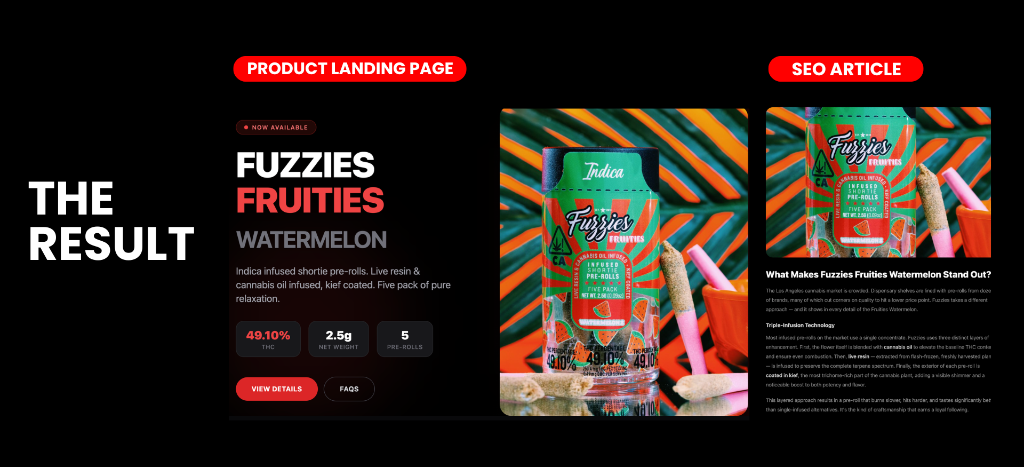
The first half of the demo started with a single product image and a structured prompt. The workflow reads the creative, takes the brand direction supplied with it, and generates a landing page built for search:
- Product descriptions written to convert rather than describe
- Key features and the characteristics that actually differentiate the SKU
- An FAQ section aimed at the questions buyers ask before purchase
- Page architecture built for local search visibility
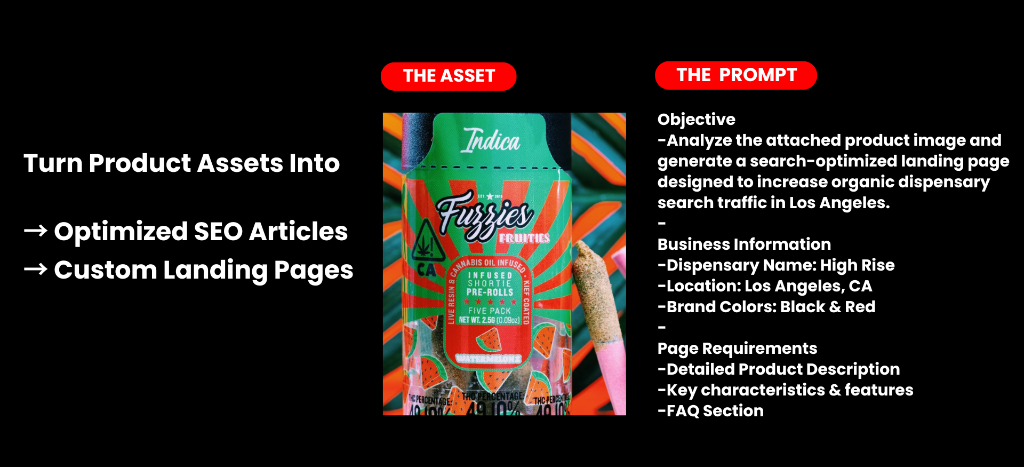
The output is a page plus article-ready content that supports product discovery and long-tail search. For a brand launching several SKUs a quarter, that is the difference between every product having a real home on the web and most of them living only as a menu tile on someone else's platform.
Part 2: converting sales data into a content calendar
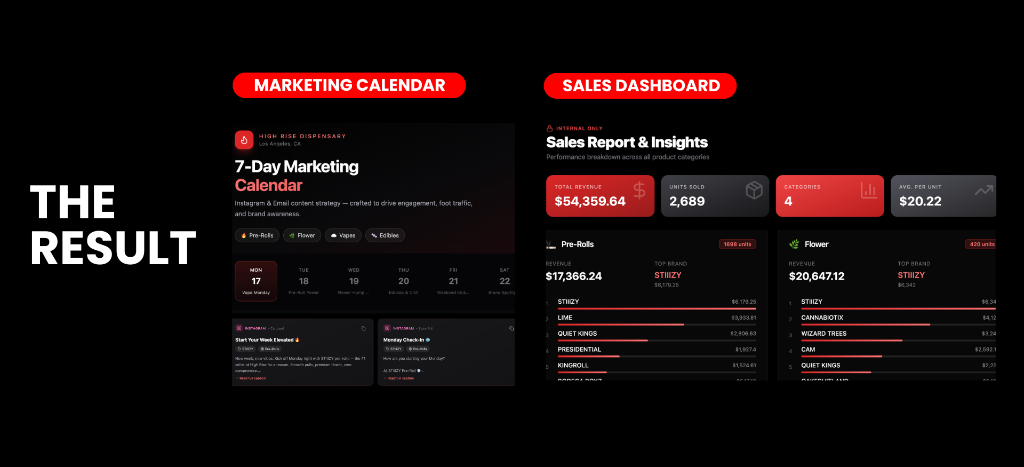
The second half moved from creative to data. Feeding retail sales reports into the system surfaces which categories are moving, which are stalling, and when the timing opportunities sit for social, email, and SMS.
- A seven-day marketing calendar built from what is actually selling
- Instagram post concepts with captions
- Email campaign angles tied to category performance
- A dashboard view of top categories and slow movers
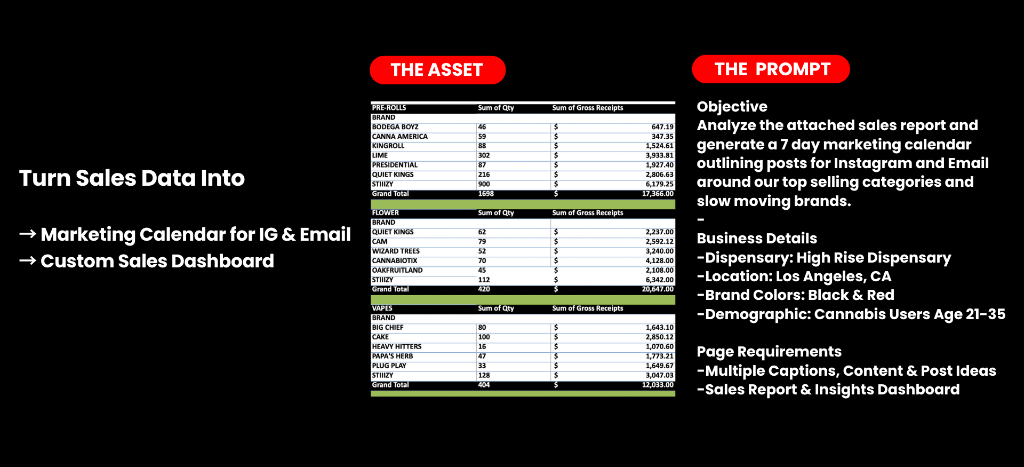
This is the half most brands skip. Marketing calendars in cannabis are usually built from what the team feels like posting, or from a holiday grid that has nothing to do with inventory. Building the week from sell-through data means the content is pushing product the retailer actually has on the shelf — which is the only version of social media a retail partner cares about.
The underlying discipline is the same one in our breakdown of how to turn dispensary sales data into marketing decisions: clean the export first, then let the data set the priorities rather than confirm them.
What this workflow does not do
A demo is a demo, and an honest one names its limits. This workflow compresses production time. It does not replace judgment, and there are places it will actively hurt you if you let it run unattended.
It does not check compliance. Generated copy will happily produce an effect claim, a health implication, or a superlative that a licensed brand cannot publish. Every output needs a human who knows the category reading it before it ships. In a regulated market that review is not optional overhead; it is the job.
It does not know your contracts. Generated retail or partner content can reference a relationship, a co-branding arrangement, or an availability claim that is not accurate. The system knows what is in the file you gave it, not what you signed.
It does not fix a weak position. If the brand does not know who it is for or why the product is different, faster production means arriving at the wrong answer sooner and at greater volume. Speed multiplies whatever strategy is already there, including the absence of one.
And it does not survive stale inputs. A calendar built from last quarter's sales export will confidently recommend pushing a SKU that is no longer in distribution. The workflow is only as current as the data feeding it.
What most operators miss
The instinct after seeing a demo like this is to ask which tool to buy. That is the wrong question. The teams that get value from this are the ones that already have their inputs in order — product photography labeled and accessible, brand direction written down somewhere other than in someone's head, and a sales export they can pull without asking a retail partner for a favor.
Brands without that spend their first month building the inputs, which is fine and worth doing, but it means the bottleneck was never the production speed. It was the asset library. If your product images live in three different phones and a shared drive nobody has cleaned since last year, start there. The workflow will still be waiting when the inputs are ready.
The other thing operators underestimate is that this changes what the marketing team is for. When production takes minutes, the scarce resource stops being execution capacity and becomes editorial judgment — deciding what is worth making, what to kill, and what a generated draft got wrong. That is a different skill set than managing a production queue, and teams that do not make the shift end up with a lot of published output and no point of view.
Where to start
Pick one SKU and one week. Build the landing page and the seven-day calendar from real assets and a real sales export, ship it, and read what happens. One complete cycle will tell you more about whether this fits your operation than any further evaluation, and it surfaces exactly which of your inputs are missing.
High Rise has worked in cannabis since 2012 and supported more than 500 brands and operators, and the pattern is consistent: the brands that compound are the ones that closed the gap between deciding and shipping. Speed on its own is not the advantage — it only pays when it is anchored to a real cannabis marketing strategy, a working content pipeline, and web interfaces built to convert. The technical side of how we build these systems is in our breakdown of how High Rise uses Base44.
Talk to the High Rise team about building this workflow into your marketing operations.
FAQ
Does this replace a marketing team?
No. It removes the production bottleneck and moves the team's time to judgment: what to make, what to cut, and what a generated draft got wrong. Teams that treat it as a replacement publish more and say less.
What inputs do you need before this is useful?
Product photography you can actually find, written brand direction, and a sales export you can pull on demand. Brands missing those spend their first cycle assembling them, which is worth doing regardless.
Is AI-generated copy safe to publish in a licensed category?
Not without review. Generated text will produce effect claims, health implications, and superlatives a licensed brand cannot publish. Every output needs a reviewer who knows the category before anything ships.
What was demonstrated at Hall of Flowers?
A live build using a product image and a retail sales export as inputs, producing a search-ready landing page, article content, a seven-day calendar with post and email concepts, and a dashboard of top and slow-moving categories. The full session is above.