Summer Haze Brings Tulum Nights to Los Angeles
On August 13, 2026, Summer Haze: Tulum Nights lit up The Mayan in downtown Los Angeles. Presented as a Budtender Experience, the one-night event gathered budtenders, brands, retailers, buyers, operators, media, and other cannabis industry members for product education, networking, live programming, and a nightlife-driven celebration.
The event was not designed as a traditional trade show with entertainment added at the end. Education, participation, and nightlife ran together throughout the evening. Guests moved between brand showcases, conversations, stage programming, and immersive moments while the Mayan-inspired environment gave every part of the experience a shared identity.
A Budtender Experience at The Mayan
The venue was central to the concept. The Mayan is an iconic 1920s Los Angeles theater known for its cathedral-scale interior and immersive architectural details. Its monumental forms gave Tulum Nights an existing sense of ceremony and scale, allowing the production to build on the room rather than treating it as a neutral event shell.
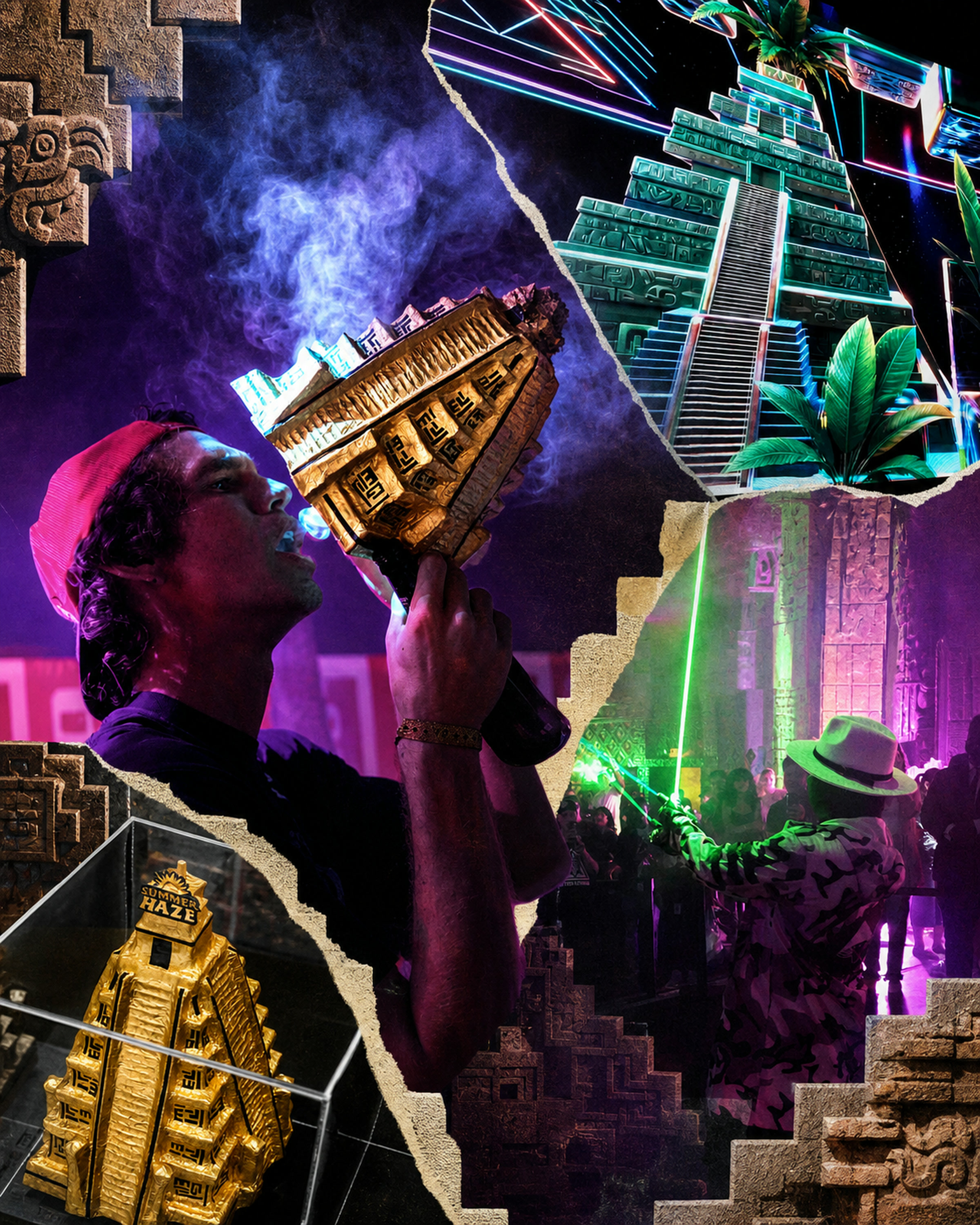
Colored light, haze, lasers, foliage, sculptural objects, digital surfaces, and crowded social zones transformed the theater into a contemporary cannabis nightlife environment. The event photography shows how the existing architecture and temporary production worked together: carved forms frame the crowd, saturated light separates activity zones, and visible beams turn movement through the venue into part of the spectacle.
That visual consistency mattered because the audience was moving through several experiences at once. A guest could be learning from a brand representative, reconnecting with an industry peer, watching a stage segment, or entering a photo-ready installation without leaving the broader world of Tulum Nights.
Connecting Budtenders With the Industry
The event is positioned as a meeting point for budtenders and the wider cannabis business community. That audience mix brought together the people who educate consumers at retail with brands, buyers, operators, media, and other partners who shape how products reach the market.
For brands, access to budtenders creates an opportunity to explain product stories directly to the people fielding customer questions every day. For budtenders, the format offers a way to compare products, meet teams, and build practical knowledge outside the pace of a retail shift. Tulum Nights turned those exchanges into the foundation of the event rather than a side conversation.
The nightlife setting also changed the tone of those interactions. Instead of separating education from community, the event allowed both to happen in the same space. Product conversations could begin at a showcase and continue through the evening as guests moved between programming, hospitality areas, and shared experiences.
The Discovery Map Made Education Active
One of the clearest examples of the event’s education strategy was the discovery map. Guests received a map and made their way through participating brands, collecting education stamps as they visited. Completed maps could be turned in for entry into a raffle featuring vendor prizes.
The mechanic gave attendees a reason to explore beyond the first familiar logo or the busiest activation. It also created a simple structure for brand representatives: each stop became a chance to introduce the product, explain what made it distinct, answer questions, and mark the guest’s progress.
That combination of education and incentive can be especially effective at a crowded event. The map gives the room a route, while the raffle creates momentum without replacing the value of the interaction itself. Guests still had to meet the brands and gather information; the prize system simply rewarded a more complete tour.
A Sponsor Ecosystem Across the Event Floor
Rather than presenting every sponsor in an identical booth format, the evening mixed product showcases, education, hospitality, visual displays, and live mentions. That variety helped the brand ecosystem feel integrated into the event’s rhythm. Guests encountered companies through both direct conversations and the programming unfolding around them.
Are You Smarter Than a Budtender?
Budtender knowledge moved to the main stage through “Are You Smarter Than a Budtender?” Presented by Dime Industries and Cannabis Capitol and hosted by Adam iLL, the game gave the event’s core audience a visible role in the live program.
The concept worked because it treated budtenders as knowledgeable industry participants rather than only event guests. Cannabis education became entertainment, and the room could engage with product and category knowledge in a format built for reactions, friendly competition, and crowd participation.
That positioning reinforced the larger purpose of Summer Haze. Brands were present to share what they make, but budtenders were present as the people who translate those stories for customers. Putting their expertise on stage made that relationship explicit.
Entertainment Built Around the Tulum Theme
The live program extended beyond the game. Event coverage described a Mayan temple-shaped joint created for the crowd, a laser-assisted performance, giveaways, hosts, and a steady flow of brand and guest moments. Each element supported the sense that this was both an industry gathering and a summer nightlife event.
The temple-shaped joint became a physical expression of the theme: recognizable at a distance, connected to cannabis culture, and memorable enough to anchor photos and crowd reactions. The laser performance used haze and the theater’s vertical scale to turn light into a moving part of the architecture.
These moments gave the night a sequence. Guests were not simply circulating among static displays for several hours. Stage segments, performances, raffle activity, product conversations, and social encounters created shifts in attention while keeping the audience connected to the room.
Why the Environment Worked
Tulum Nights succeeded visually because the theme appeared at several scales. The Mayan’s architecture established the largest forms. Lighting and haze shaped the room. Portals, objects, booths, screens, and foliage created mid-scale destinations. Product displays and branded details rewarded closer attention.
The recurring palette of magenta, violet, cyan, green, and warm gold kept those layers connected. Lasers and illuminated frames created strong portrait locations, while the surrounding architecture remained visible enough to place each guest inside the larger event.
This gave the content library useful range. Wide images show attendance and production scale. Portraits center the people who animated the evening. Activation images document brand participation. Detail photographs preserve the objects, lighting, and visual motifs that made Tulum Nights distinct.
Documenting Summer Haze: Tulum Nights
The final visual story captures the event from several perspectives: the scale of The Mayan, the density of the crowd, the brand discovery route, live programming, sculptural details, laser light, and individual guest moments. Together, those views explain both what happened and how the night felt.
Layered collage treatments extend the event’s stone, smoke, jungle, and neon language into the post-event presentation. Rather than reducing the experience to a sequence of isolated photos, the compositions place architecture, people, activations, and movement inside the same frame.
Explore the complete Summer Haze: Tulum Nights case study to see the event video and full image gallery.
Frequently Asked Questions
What was Summer Haze: Tulum Nights?
Summer Haze: Tulum Nights was a Budtender Experience produced by Canna Management Group in collaboration with High Rise, THC Members Only, and Nothing But Fire. It combined cannabis brand education, networking, sponsor activations, games, giveaways, and live entertainment in a Tulum-inspired nightlife environment.
When and where did the event happen?
The event took place on August 13, 2026, at The Mayan in Los Angeles.
Who attended Tulum Nights?
Over 1,500 budtenders, brands, retailers, buyers, operators, media, and other cannabis industry members.
How did the discovery map work?
Guests visited participating brands and collected education stamps on a discovery map. Completed maps could be submitted for entry into a vendor-prize raffle.
What was “Are You Smarter Than a Budtender?”
It was a live cannabis knowledge game presented by Dime Industries and Cannabis Capitol and hosted by Adam iLL. The segment placed budtender expertise at the center of the event’s entertainment program